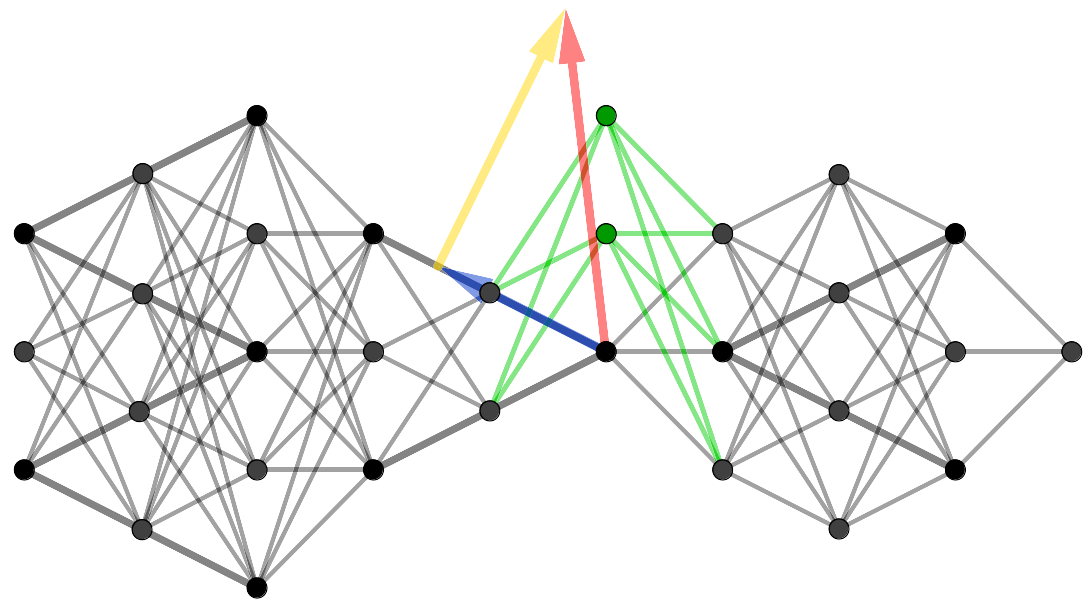
gromo.growing_module.AdditionGrowingModule#
- class gromo.growing_module.AdditionGrowingModule(post_addition_function: Module = Identity(), previous_modules: list[AdditionGrowingModule | GrowingModule] = None, next_modules: list[AdditionGrowingModule | GrowingModule] = None, allow_growing: bool = False, tensor_s_shape: tuple[int, int] = None, device: device | None = None, name: str = None)[source]#
Module to connect multiple modules with an addition operation. This module does not perform the addition operation, it is done by the user.
- add_next_module(module: AdditionGrowingModule | GrowingModule) None[source]#
Add a module to the next modules of the current module.
- Parameters:
module – next module to add
- add_previous_module(module: AdditionGrowingModule | GrowingModule) None[source]#
Add a module to the previous modules of the current module.
- Parameters:
module – previous module to add
- compute_previous_m_update() tuple[Tensor, int][source]#
Compute the update of the tensor M for the input of all previous modules.
- Returns:
torch.Tensor – update of the tensor M
int – number of samples used to compute the update
- compute_previous_s_update() tuple[Tensor, int][source]#
Compute the update of the tensor S for the input of all previous modules.
- Returns:
torch.Tensor – update of the tensor S
int – number of samples used to compute the update
- compute_s_update() tuple[Tensor, int][source]#
Compute the update of the tensor S. Should be added to the type of layer.
- Returns:
torch.Tensor – update of the tensor S
int – number of samples used to compute the update
- delete_update(include_previous: bool = False) None[source]#
Delete the update of the optimal added parameters.
- forward(x: Tensor) Tensor[source]#
Define the computation performed at every call.
Should be overridden by all subclasses.
Note
Although the recipe for forward pass needs to be defined within this function, one should call the
Moduleinstance afterwards instead of this since the former takes care of running the registered hooks while the latter silently ignores them.
- parameters(recurse: bool = True) Iterator[Parameter][source]#
Return an iterator over module parameters.
This is typically passed to an optimizer.
- Parameters:
recurse (bool) – if True, then yields parameters of this module and all submodules. Otherwise, yields only parameters that are direct members of this module.
- Yields:
Parameter – module parameter
Example:
>>> # xdoctest: +SKIP("undefined vars")
>>> for param in model.parameters():
>>>     print(type(param), param.size())
<class 'torch.Tensor'> (20L,)
<class 'torch.Tensor'> (20L, 1L, 5L, 5L)
- projected_v_goal() Tensor[source]#
Compute the projected gradient of the goal with respect to the activity of the layer.
dLoss/dA_proj := dLoss/dA - dW B[-1] where A is the pre-activation vector of the layer, and dW the optimal delta for all the previous layers
- Returns:
projected gradient of the goal with respect to the activity of the next layer dLoss/dA - dW B[-1]
- Return type:
torch.Tensor
- set_next_modules(next_modules: list[AdditionGrowingModule | GrowingModule]) None[source]#
Set the next modules of the current module.
- Parameters:
next_modules – list of next modules
- set_previous_modules(previous_modules: list[AdditionGrowingModule | GrowingModule]) None[source]#
Set the previous modules of the current module.
- Parameters:
previous_modules – list of previous modules
- sum_in_features(with_bias: bool = False) int[source]#
Count total in_features of previous modules
- Returns:
sum of previous in_features
- Return type:
- sum_out_features() int[source]#
Count total out_features of next modules
- Returns:
sum of next out_features
- Return type:
- update_scaling_factor(scaling_factor: Tensor | float) None[source]#
Update the scaling factor of all next modules and the _next_module_scaling_factor of the previous modules. Does only work if previous and next modules are GrowingModule.
- Parameters:
scaling_factor (torch.Tensor | float) – scaling factor to apply to the optimal delta